The composer as artisan
As we grow up, we are given visions of composers producing master works that entertain the masses, but are we in fact just local artisans producing colourful musical objects?

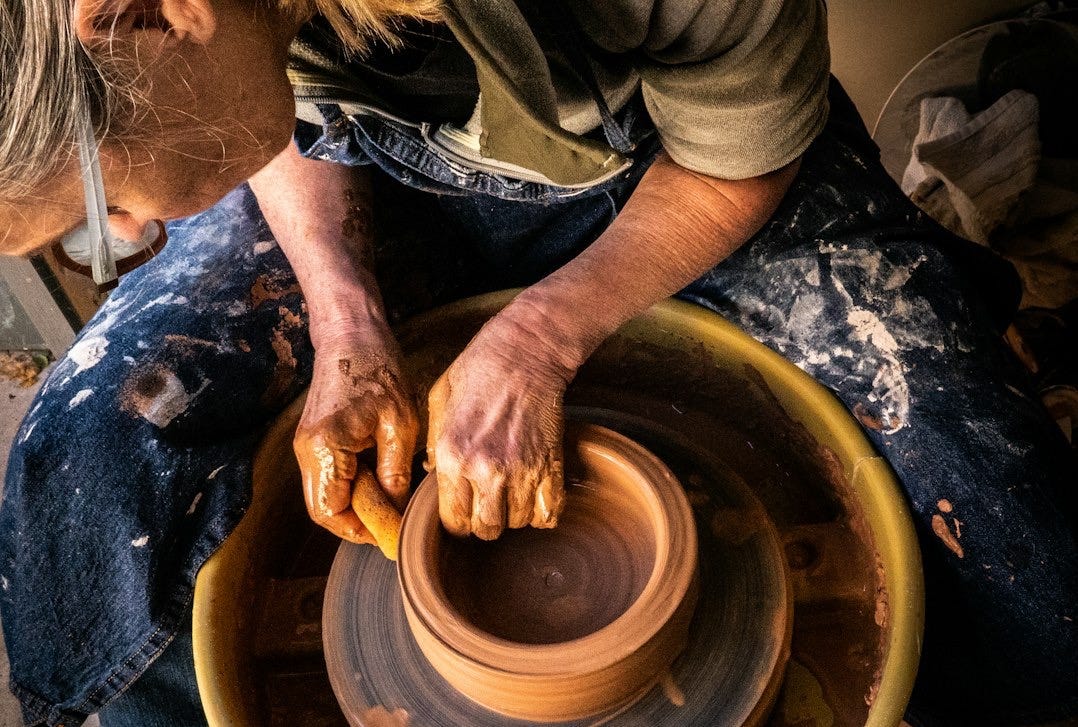
I grew up in the small village of Cromarty on the east coast of Scotland. It was traditionally a fishing village with a harbour in the Cromarty Firth, a calm basin housed between two peninsulas. In the 90s its focus was not on fishing. Instead it was a mixture – on the industrial end were hardy local lads drilling for oil on the rigs. The largest economy in the area was tourism, with hotels, cafes, restaurants and dolphin cruises.
The other businesses Cromarty housed were small artisanal producers offering graphic design, media, furniture renewal, fine art, baked goods and latterly beer. One of these businesses was a pottery – a small bothy in a row of cottages. It was always busy and outside the pottery was a stack of new bespoke pots and a hot kiln. It was impressive but I can’t help but wonder – how did they make that work?
Even if there was a stream of customers passing the shop at all times, they would be unlikely to sell more than two high value items every couple of days. As it was the pottery sat back from the street on the shore, away from the main shops, such as they were, and not obviously accessible to the public, except through a sign placed near the road. Perhaps I’m underestimating their reach, and perhaps online shopping has made their business boom in recent years. You can check it out in fact – here it is. They are lovely artistic pieces, and I certainly wouldn’t devalue that work.
Property is legendarily cheap in Scotland, and there is every chance that the potter makes ends meet sufficiently with this small amount of work, but my guess is that it’s supplemented with other work, and that a decent portion of income comes from commissions – bespoke pieces for presents, anniversaries or just a nice art piece for the wall.
It makes me think about our role as composers. The uncomfortable truth about our profession is that even those of us that are institutionally recognised for our work don’t make a living solely on the things that we create.
There are the standard big hitters – pieces that a choir might pick up and it becomes part of their repertoire, from which we get a steady dribble of royalties and sheet music – these are the small pinch pots and standard cups of the pottery – the kind of thing that ends up cluttering up your cupboard because you can’t bear to throw a memory away.
Then there are bespoke commissions – pieces for occasions, arrangements, sometimes a piece with a specific brief for an orchestra and quite rarely, an “anything you like” commission. Then there are other services that artisans can give – tuition, engraving, orchestrating, editing, reducing. All of these are different income streams that a composer might have. I also work as conductor, pianist and teacher.
The reason I’m laying all this out there is that I think it’s a bit of a myth that a composer is a person on standby ready to create a work on call, and that that work will be a masterpiece that pleases the masses, creates ticket sales and sheet music and be virulently successful and thus achieve success and be known worldwide. We also rarely see their full output – it’s much more likely that we see their big hitters only, as these are the pieces that publishers will hold. We also rarely know the circumstances and agreements of commissions.
So if we’re thinking about composers being artisans, like potters, the question I’m wondering about, is what about all the little arty pieces that festoon the walls when you enter the shop? Not the identical big hitter jugs, cups and pinch bowls with “Cromarty Pottery” and a picture of a lighthouse on the side, but all the colourful bits hanging from the ceiling, nice coloured tiles, wall hangings?
We like to think of composers being commissioned to write a piece, going away and writing it, and then handing it in. The reality is that the creative mind never really rests. Whether they’re writing Substacks about it, creating videos or actually writing music, composers are always making something.
We can’t help it – it’s compulsive. We need to create.
When I worked for the artistic director of a local professional choir, and he invited me to show him some work at the appropriate moment, I didn’t just write one piece – I created 18 works and fired them off to him one at a time. At one point I was writing roughly one a week. Only three of them were picked up. In pottery terms, I’d been at my wheel all week creating piece after piece until I found exactly the right three that would please a local investor.
When I took over the Wombourne and District Choral Society, my instinct for the first concert was to write half of it – arranging a carol here, writing a fantasia improvisation for organ there, introducing one of my own works. The programme order initially had my name printed in it about 6 times before I relented and replaced it with “Trad.” for the arrangements, and unattributed the improvisation for fear of being accused of big-headedness.
Every composer I know does it, whether they have employment as a composer or not. If they’re not composing to commission, they are composing speculatively – writing something to send to someone or to a competition.
At some point in their career, every musician has to reckon with the fact that not all of the work they do is going to net them economic benefit. It’s the fact of all professions that you need to speculate to accumulate.
Many of the “call for scores” opportunities you can apply for advertise for works that have already been written, but that have not yet had a performance or been published. This signals two things – 1) the caller will not pay commission and 2) the caller wants to be seen to be promoting new work, possibly for funding. It’s a way of getting something for nothing and, some might say, a cynical way of exploiting this need to speculate. Often these works are bespoke – for a particular unusual set of instruments, or to a commission brief that suits their concert, and the composer will end up writing a piece to satisfy the brief rather than using something they’ve already written.
The darker side of this economy is an industry that ends up exploiting the labour of composers. Some calls for composers and competitions even have a fee attached – “write a piece for this opportunity, pay us, and we’ll look at it and pocket your fee. You’re welcome”. Often these are international, and it’s never clear whether there is actually a winner, actually a performance or whether it makes any difference at all. You end up speculating money as well as hours of work for basically an empty promise. Basically – here is an invitation for 50 potters all to spend two weeks creating a masterpiece vase. One potter will be paid for their work, we promise.
At what point does speculation turn into exploitation? Often composers just want their pieces to be performed – for that work to have meant something, and to be able to realise the vision they have in their head for how music can go. There’s nothing quite like premiere day – a train ride to the venue, a coffee at the station, an enjoyable morning discussing your work with players, and then an exciting seat in the audience while your heart is poured out on stage. Without a performance, composition can end up being just writing dots on a page.
I guess the reason I’m drawing attention to the idea of artisanal composition is that I’ve been wondering about the role of the composer, and what on earth we add to the conversation that is new music. Do people really need new music? There are thousands of recordings online just a few keystrokes away. There are now AI generated works and there is a large industry surrounding entertainment. Why go to a potter making hand-made pieces when you can just buy a cup from IKEA for a fraction of the price?
Composers offer bespoke, artisanal music that at its best amounts to high art. I’m employed to write arrangements for a school that I work for precisely because they need something that works and sounds good with the forces they have. The idea of a Beethovenian composer creating hit after hit to fill concert halls is a mythical image of a composer’s life.
The value we offer is in the unique qualities of the work and the circumstances surrounding its creation. When people visit Cromarty they’ll probably have a lovely relaxing holiday, go on a boat, see the dolphins, climb the one hundred steps and spend some time in the cafes. They’ll see a lovely local pottery shop with pieces that remind them of the time they spent there and are unique to the place, created by one human artist that they probably spoke to while they were there.
Composition offers that same value whether on a local or international level. What price you place on that value is up to you. Are you more content pushing out little mugs with lighthouses on them, are you angling for the bespoke wedding commissions with a little bride and groom glazed on and “Mr and Mrs Barbachuke 12/5/27”? Or are you looking for the eccentric billionaire tourist that wants a completely unique piece to display in their gallery?
Art exists as a compromise – it is rarely “pure” craft or “pure” art, no matter how eccentric the billionaire tourist is. I blanche when someone asks something like “will you write a piece for my wedding” because I’m just not as comfortable with the craft end of the spectrum representing me as a composer. I’m sure I could create a competent setting, but my brain tends towards being the guy making weird little pieces with a high price tag, and the “unique” commission. The husband wandering into my pottery looking for a nice little piece for his wife will probably enjoy the uniqueness of the work but turn around smartly when he looks at the price.
Near me is the Stourbridge Glass Quarter. It’s a sector that used to be a crucial local industry. Glass factories back onto canals that took finished products all over the world. The most famous is the Glass Cone – a conical building that dominates the skyline between Stourbridge and Kingswinford. This is now a museum and there are very good videos exploring the factory process of mass-producing glass by hand. These were highly skilled crafts people doing the kind of detailed replication that machines now do.
The industry no longer exists but in the Glass Cone are a few studios of artisanal glass makers – where industry fails, artists gain value. Every time I go there, I am amazed by the art they produce – incredibly large sculptures full of colour and life. I think wow – this would make a lovely piece to give to the wife for a big birthday present and display proudly in our home.
Then I look at the price…
Oh this is an exciting topic. So much that can be expanded on, perhaps in the future…
But I will share a short story now. I once had the mirror experience of being a performer exploited by peer composers. I inherited the reigns of a commission project from the former AD of a chamber group I was in that I thought were under the auspices of a collaborative project–that our group and the composers (2) would jointly fundraise/crowdsource for in order to properly pay composition fees as well as performance labor. This was not the case. Our group did all the networking and funding footwork, with a majority of the fees coming from my savings just to fund this project that I believed would be a rewarding interdisciplinary experience (I did not yet realize that this was just a commission proposal to the composers).
After receiving contracts and distributing pre-completion fees, the composers proceeded to drop the ball and break contract at every step. No materials delivered by any agreed dates. No timely communication updates. We were not institutionally supported, patronized, or sponsored by anything; just a cohort fresh out of grad school trying to gain a footing in the industry as performers eager to get “diverse, living composers” (not scare quotes, but this of course is an industry marketing angle for chamber groups to launch academic classical careers) work. One composer eventually blamed me on a joint project call for racism and sexism, while simultaneously victimizing and infantilizing herself, simply because I suggested rudimentary changes after reviewing a late draft (which were contractually obliged, according to her own contract!). She did not like the ego check, and backed out of the project. The other composer then, on a later private phone call, proceeded to accost me for; failures of identity fealty, condescendingly lecture to me about what is morally correct in a DEI situation (despite sharing similar attributes as myself), gaslight me over what happened in the earlier scenario (going as far as to suggest that tone cannot be understood in email writing, as if the entirety of any literary tradition does not exist), and act as though offering to take on the remaining compositional work was a blessing to save us (me) from embarrassment.
This all happened in the context of my also having a background in political science and philosophy, where I am intimately familiar with various ideological tactics that predominate contemporary socio-politics. It was during this phone call that I realized the composers were in it for the commissioning fee, not a collaborative project we could build together. Offering an alternative position to how the situation played out fell on deaf ears. Ironically, the latter composer agreed that my editing suggestions were correct towards the first composer. This composer then took three additional years to complete the project work, eventually capitulating at the threat of arbitration over collecting repayment for contractual failures (and admitting this is not the first time their failures have resulted in ultimatums).
The lesson in all this, to me, is that composers and performers should NOT be competing against each other in an industry (Classical, in this case) that has oppressively restrictive infrastructure and a lack of robust systems to cultivate artistic musical labor into its ecosystem, just to climb social and professional ladders. We’re on the same side, with the same interests, especially if you both compose and perform! This is all to say; turning towards local, regional scenes where various strains of sustainable work for composers AND performers can be carved out as artisans is currently essential with the way classical industry machinations play out.